Seven Rainy Days in Istanbul
Or: how a war I had nothing to do with rerouted my trip, and how a city I had long wanted to walk through opened up under grey skies anyway.
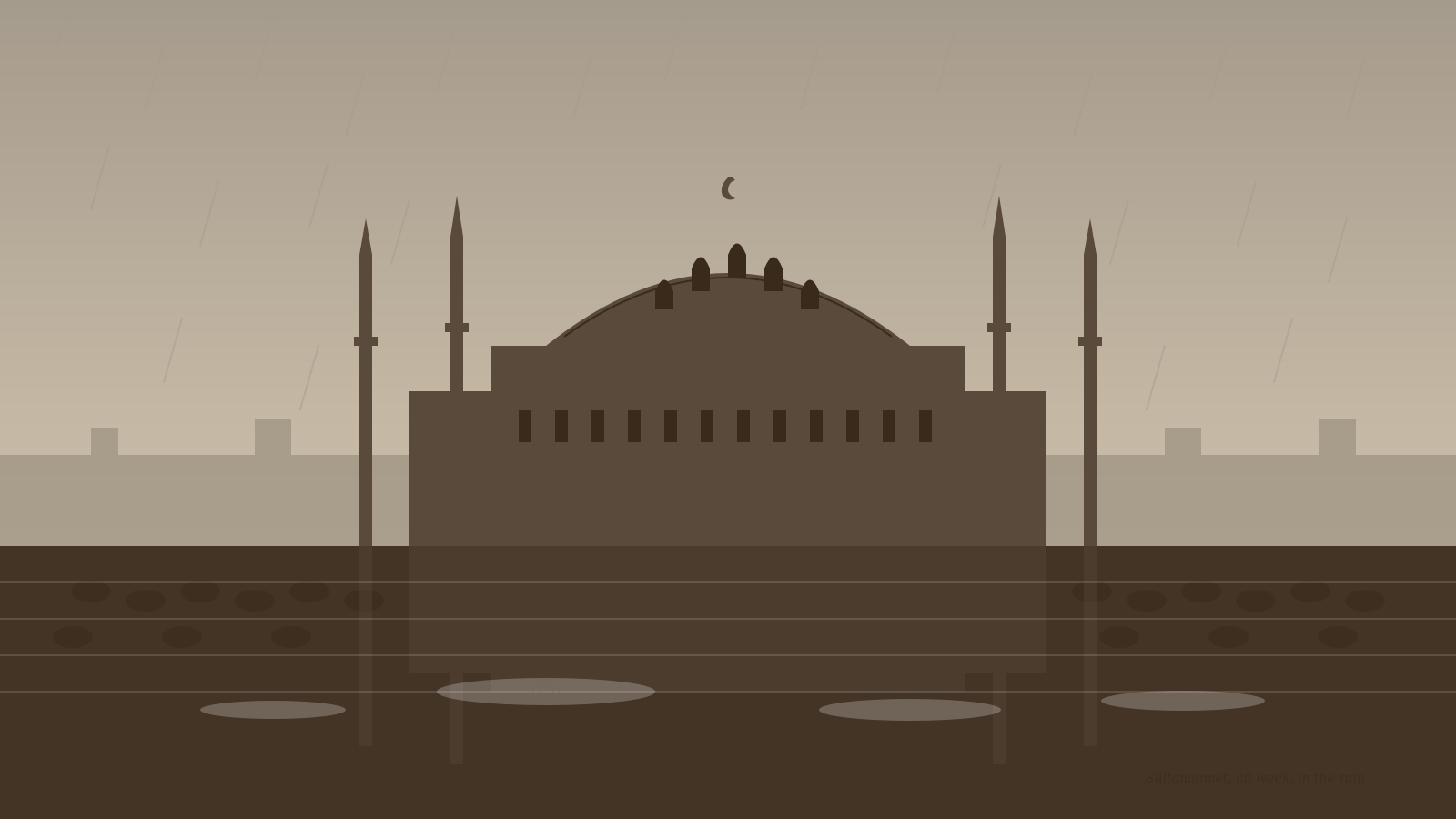
I had booked the trip three months in advance.
Manchester to Istanbul. A week in the old town. Then Istanbul to Islamabad to see family. A clean shape on a calendar, the kind of plan you make in autumn, when winter feels like a problem you can solve with two flights and a hotel reservation.
Then the news started to fold in on itself.
A strike. A counter-strike. The careful language of escalation, and the carefully careful language of restraint. Two governments leaning, slowly, toward something neither could quite afford. The conflict between Iran and the United States had been simmering for years. Now it was at a low boil, and the sky over a long stretch of the Middle East was starting to feel less like air and more like a question.
I checked my second leg three times in two days. My route, like most routes from Europe to South Asia, drew a long arc that brushed Iranian airspace. Some airlines began rerouting. Other flights vanished from the schedule. Mine, in the end, survived. The onward leg got reshuffled but didn't disappear.
I was lucky in the small way that people in transit get to be lucky, which is mostly a matter of which border you happen not to be near.
I have been doing this, moving through the world for work, for family, for curiosity, long enough to have outgrown the assumption that the world will let me. And still, every time geopolitics reaches into my plans, it lands the same small surprise. I had nothing to do with this. And yet.
I think a lot, in those moments, about how much of the freedom of modern travel is borrowed against a stability nobody has actually promised. We act as though the planet's open skies are a feature of the world, when really they are a feature of a particular kind of peace, held together by people most of us will never meet. When that peace wobbles, even at a distance, even in a country whose news we follow only in passing, a hundred thousand journeys reorganise themselves quietly, in the background. Holidays cancelled. Family visits rebooked. Someone, somewhere, missing a wedding.
There is no good way to feel about that except small. Small, and grateful, and slightly ashamed at how easy it had once seemed.
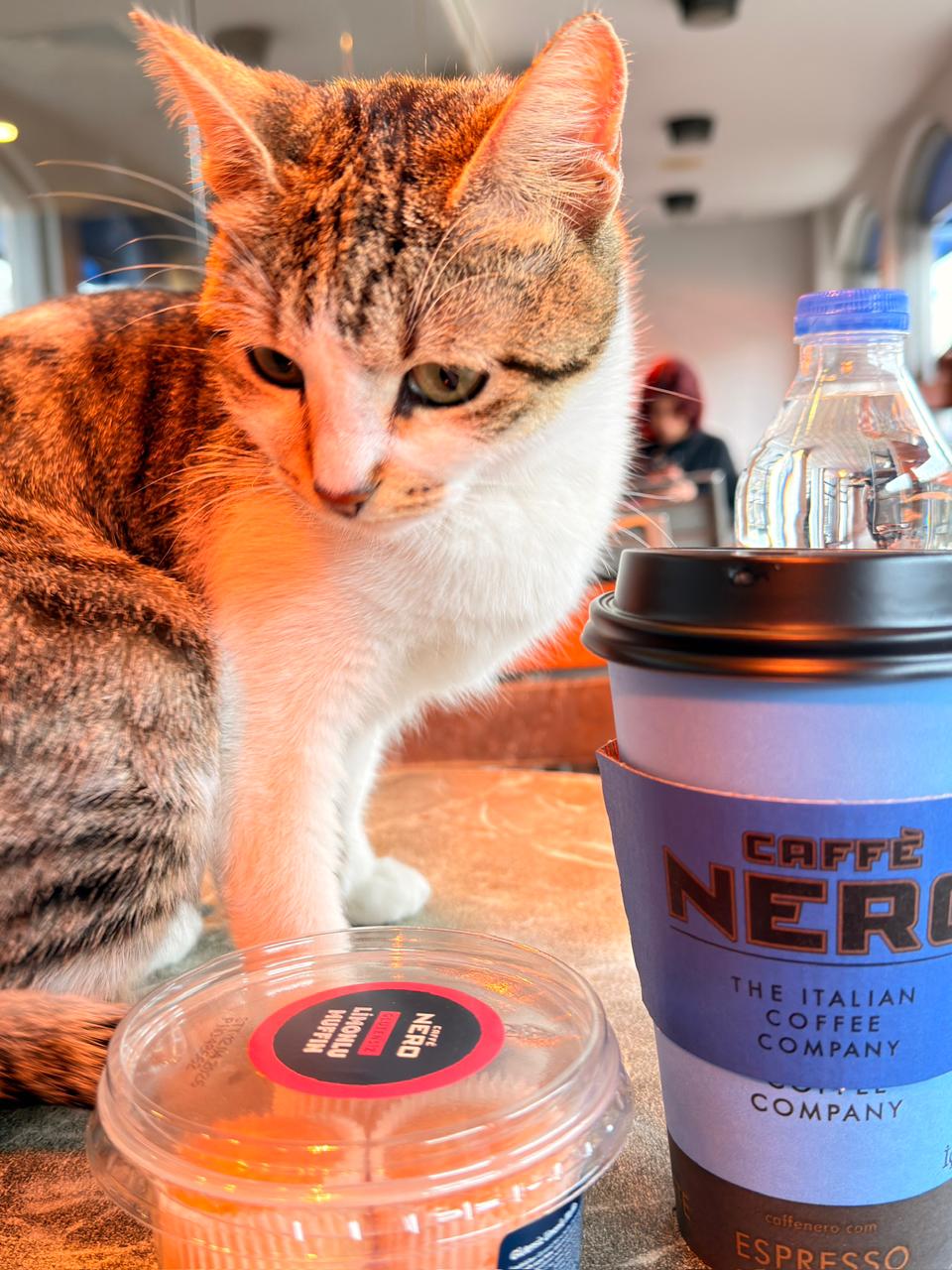 A Café Nero, and unexpected company.
The first coffee
I held a Café Nero flat white at Manchester Airport with both hands and watched the rain blur the runway through the window. Jet2's orange livery sat on the tarmac like a cheerful argument against the weather. Around me, the usual airport choreography: boarding announcements in two languages, suitcases dragged on tired wheels, someone's child explaining something important to a tired parent.
The coffee was good. The flight was, predictably, delayed.
I have always liked the small ritual of a cup of coffee at a departure gate. It is one of the few moments left in modern travel where you are forced to stop, to sit, to sip, to wait. Everything before that point is logistics. Everything after is motion. The coffee is the seam between them.
This one tasted of departure.
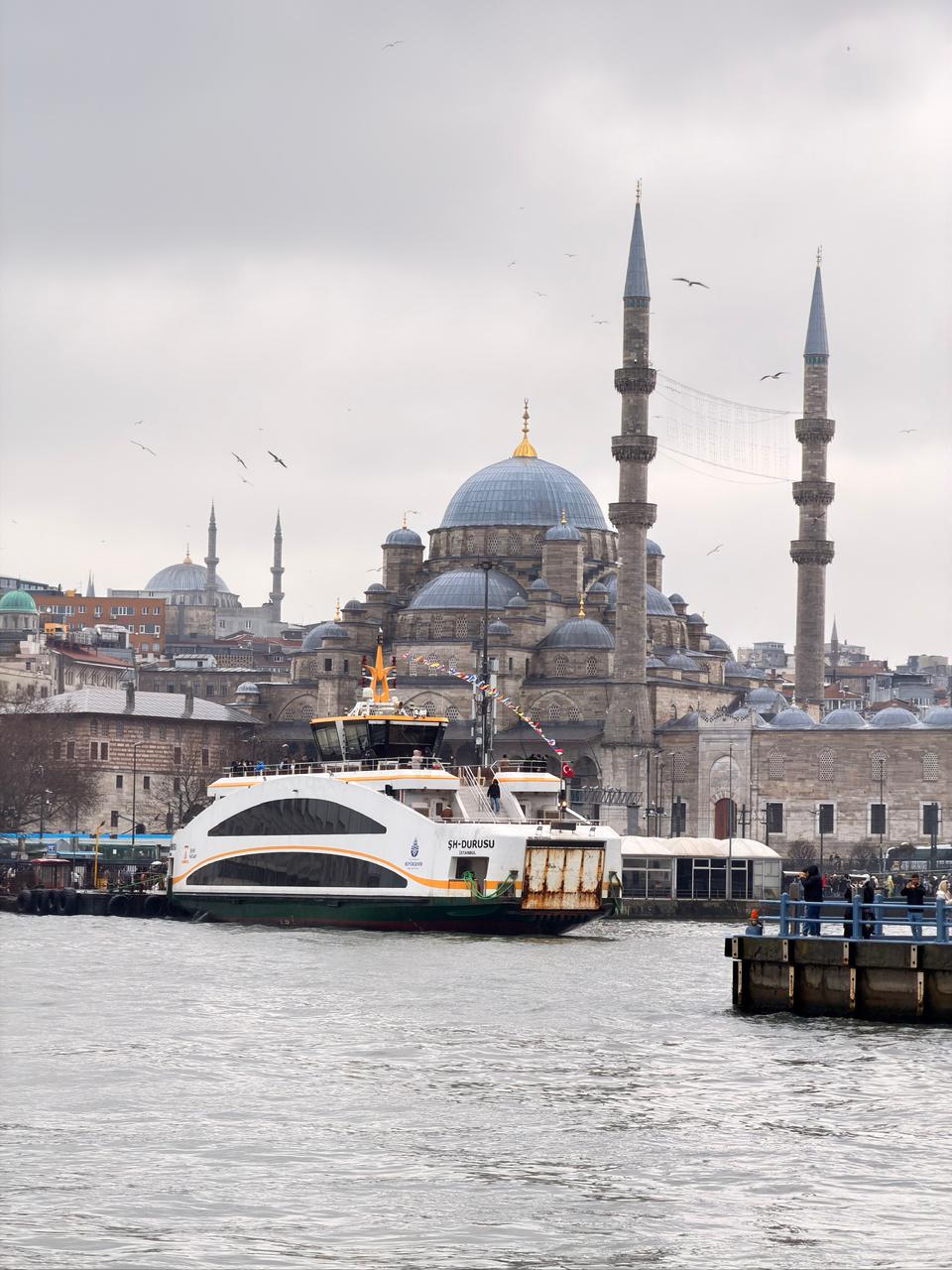 Eminönü on a grey afternoon, the city doing what it has always done.
Arrival, Friday night
I landed in Istanbul on a Friday night in heavy rain, three hours behind schedule. My body was confused about the time. My phone was confused about the network. The terminal was warm and full of voices I half-understood: Turkish, Arabic, Russian, Urdu carried over from another flight that had landed nearby. Outside, through the wet glass, the runway lights smeared and ran.
I had booked a chauffeur transfer through trip.com, where I'd snagged a useful discount for being a Diamond-tier user. (A genuine recommendation, not a sponsored line: I have booked something north of forty flights and fifty hotels through the app over the years, and the loyalty actually compounds in ways the marketing rarely tells you.) My driver was waiting with a quiet sign and a quieter smile. We drove the long road into the city through curtains of rain. Headlights of the cars ahead of us bloomed into the windscreen, ferry lights blurred across the water on our left.
Istanbul on a wet night is a city of reflections.
Every surface holds a second city in it. Minarets doubled in the puddles. The Bosphorus turned the rain into another sky. We passed an old aqueduct lit from below, and for a second the wet stone looked older than it was, which is to say, exactly as old as it was.
We pulled up to Cube Suites Hotel in Sultanahmet, a four-star boutique place tucked into the old town, close enough to the Blue Mosque to walk, quiet enough at night to hear the rain on the cobbles. The reception was lit warm and low. A man behind the desk welcomed me by name in a way that made me wonder, briefly, how he had known I was the one coming through the door, and then realise it didn't matter. I was tired. He was kind.
He sent up tea before I had finished checking in.
There is a particular kind of relief in arriving somewhere kind in a foreign city in the rain, and being met by an apple tea and a lit room. I will not oversell it. But it deserves a sentence.
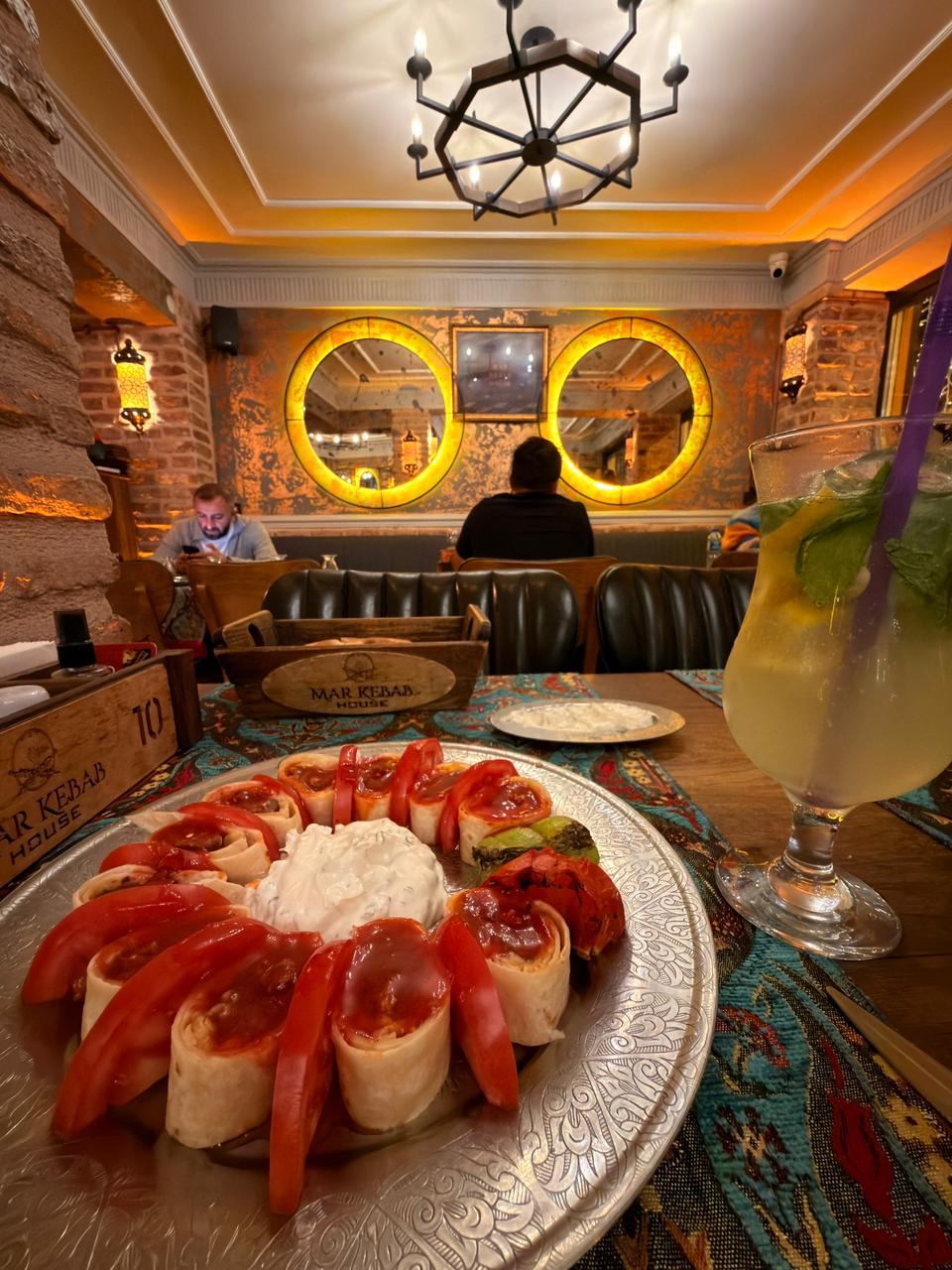 "You picked the right street." First dinner at Mar Kebab House.
The first dinner
I went out that first night because I was hungry, and because I knew, somewhere underneath the tiredness, that if I waited until morning I would have surrendered something.
The streets of Sultanahmet at night, in the rain, were almost empty. The bazaars had shut. The tourists had gone in. A few of the food places kept their doors open, warm light from inside spilling onto the wet stones, and one of them turned out to be the best meal of the trip.
I had iskender kebab: thin slices of lamb on torn pieces of pide bread, drowned in tomato sauce and butter that the waiter poured at the table from a copper pan, with a side of yoghurt that was thicker and more honest than any yoghurt I have at home. After it: şah kebab, king's kebab in Ottoman Turkish, slow-cooked, fall-apart, served with a saffron rice that had a grain texture I had not tasted since my grandmother's kitchen.
After that: tea. Always tea. Black, in a tulip glass, hot enough to need both hands.
I sat in that little restaurant for a long time. Outside, the rain went from heavy to steady to soft. The waiter, who had figured out by then that I had come from somewhere and was going somewhere else, asked where I was from, and what I did, and whether I had been to Türkiye before. I told him no. First time. He said, with the warmth of someone who has welcomed thousands of first-timers:
"You picked the right street."
I walked back to the hotel slowly. The minarets of the Blue Mosque rose above the rooftops, lit gold, the rain catching in the floodlights. I felt, and this is the only honest word for it, welcomed. Not by anyone in particular. By the city itself.
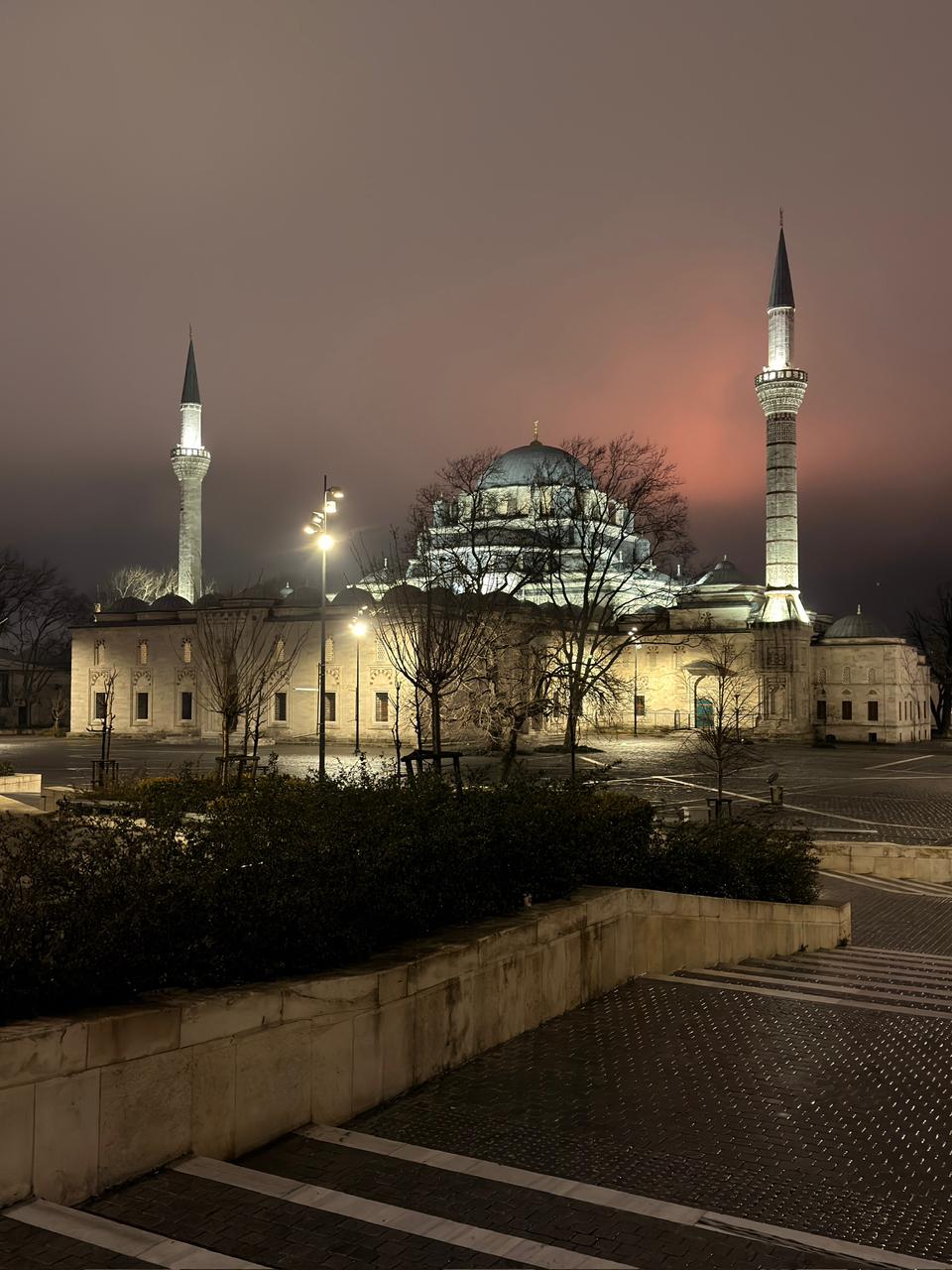 Sultanahmet at dusk, minarets lit gold.
A week of rain
It rained for a week.
I want to be honest about this, because most travel writing politely edits the weather out, and most Instagram posts pretend the sun was always shining. The reality of my Istanbul week was this: rain, rain, more rain, a pause for tea, more rain, an evening of wind that tried to take my umbrella, more rain. Sometimes drizzle. Sometimes drumming. Once, a real downpour that flooded a square in fifteen minutes and turned the gutters into small Bosphorus tributaries.
And I'm here to tell you, it was glorious.
A city like Istanbul earns the rain. Hagia Sophia in sunshine is a postcard; Hagia Sophia in rain is a cathedral of sound, with water sluicing off the dome and gargoyles I had not noticed in dry weather suddenly performing their thousand-year function. The Grand Bazaar, on a rainy afternoon, becomes the warmest, most fragrant tunnel in the world, every spice and carpet smell intensified by the damp, every shopkeeper more inclined to pour you tea because nobody is going anywhere. The Bosphorus ferries kept running anyway, plowing through the chop with the fatalism of boats that have been doing this since the Empire.
I crossed once, in a slanting rain, holding a tulip glass of tea against my coat, and watched a city that has been a city for sixteen hundred years prepare for evening. The call to prayer rolled off the hills in five different voices and arrived all at once. I kept the empty glass.
I think rain is the right weather for old places. Sun flatters them. Rain confronts them. Rain reminds you that everything you are looking at, every dome, every minaret, every cobble underfoot, has been wet a thousand times before, and will be wet a thousand times after, and that the people who built it knew exactly this when they laid the first stones.
Other small things, briefly
Some other things happened, briefly, because no week in Istanbul fits neatly in a single arc.
I got lost in the Grand Bazaar on purpose. A carpet seller poured me chai I had not asked for and asked where I was from. He had a story about every country I named.
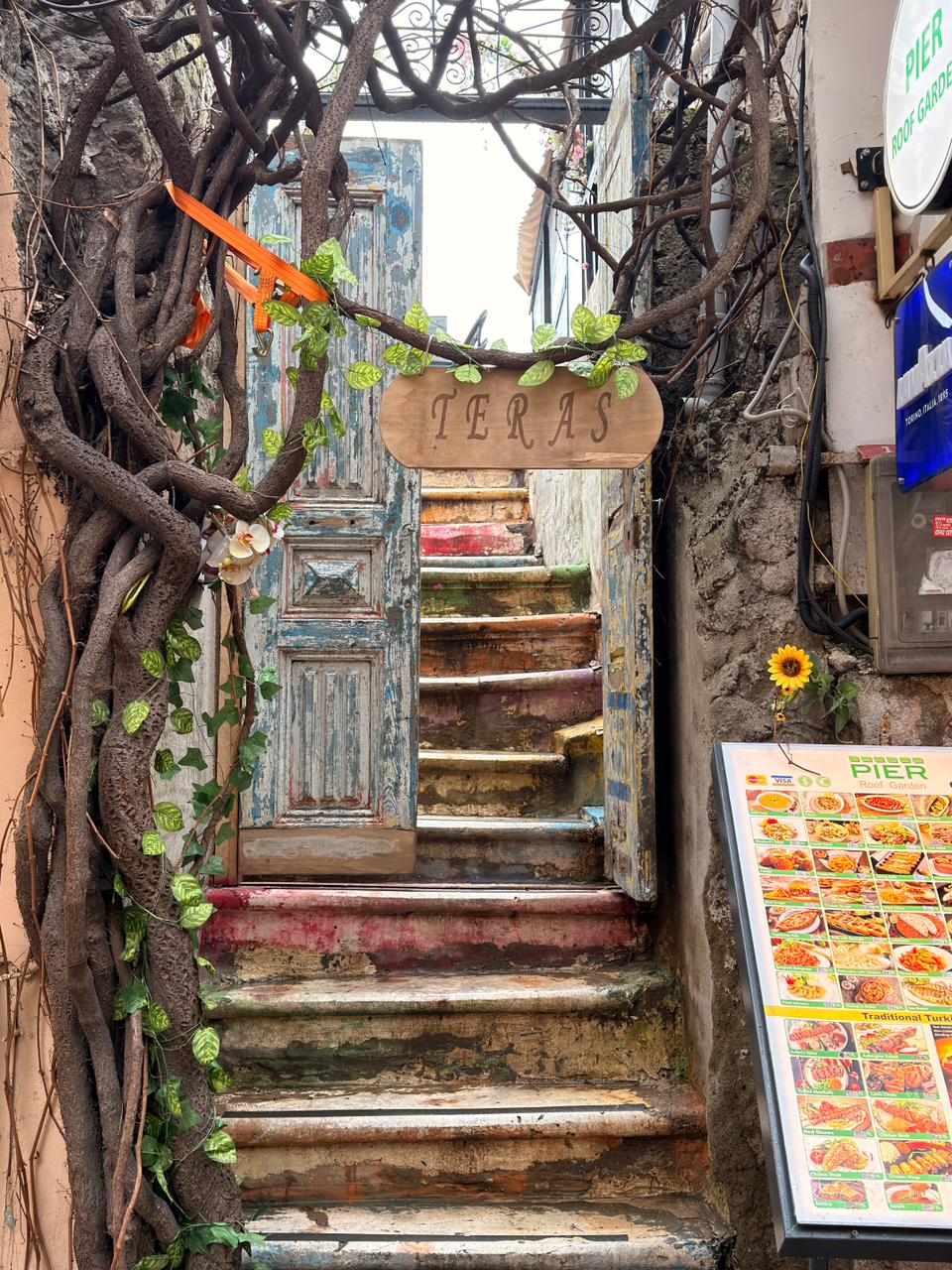 A side street in the old town. Every door opens onto something.
I went to Hagia Sophia and forgot, for a long moment, what I had come to see. There is a particular silence inside very old places, made of all the prayers said in them. You don't have to share the prayers to feel the weight.
I crossed to the Asian side at sunset, drank coffee in Kadıköy that I have been thinking about ever since, and rode the ferry back as the lights of the European shore came on, one by one.
I bought spices in the Egyptian Bazaar from a man who let me smell each one before I bought it, which I have decided is the only correct way to sell anything.
I sat in a tea garden under a leaking awning, watched the rain run off the tiles, and read a book I had brought from England and would have read anywhere. Reading it there, in that light, was the difference.
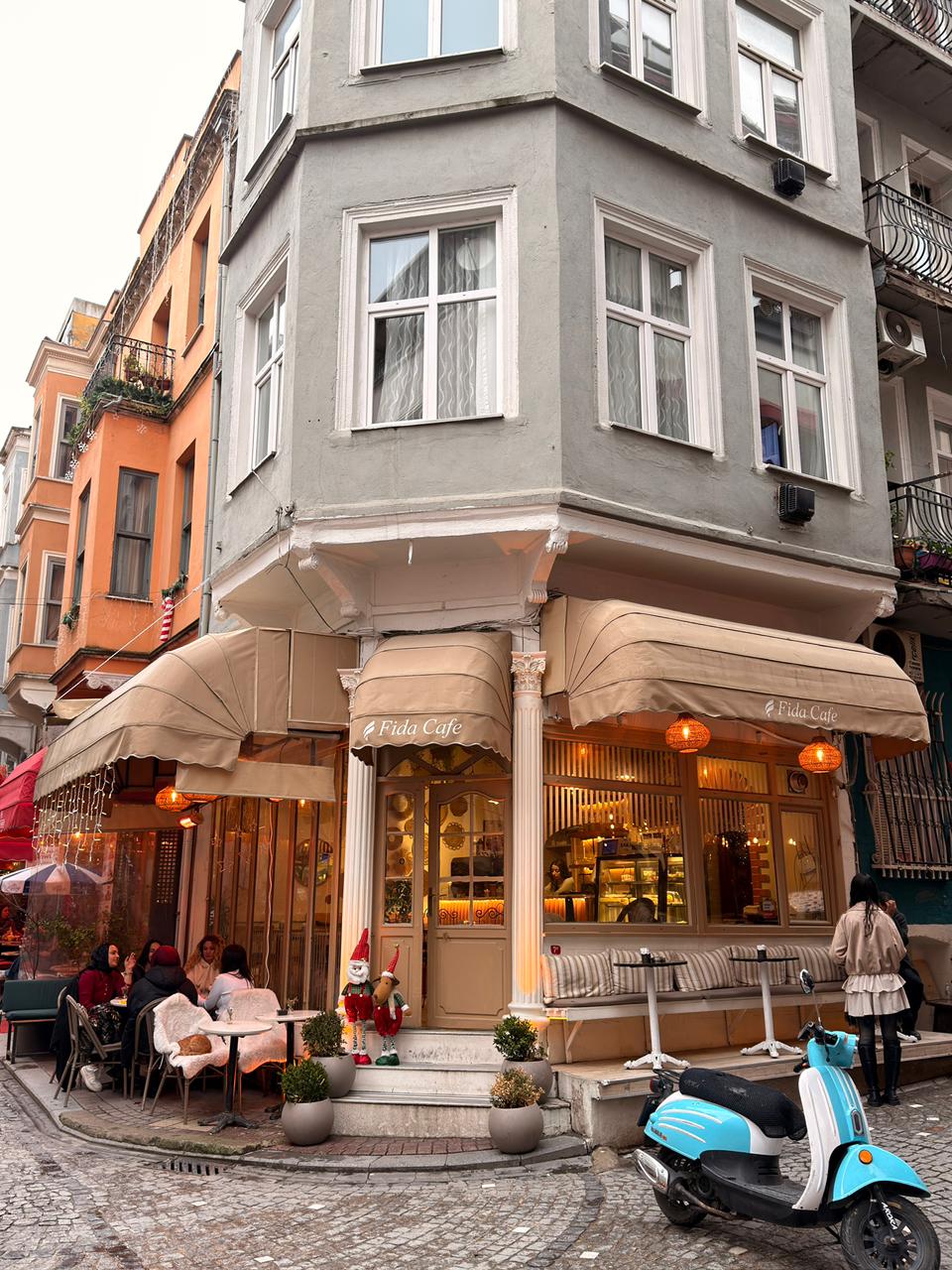 A corner café in the old town, the kind you mean to remember the name of.
Leaving
I left on a Friday, a week after I had arrived, on the rerouted onward leg to Islamabad that the war had nudged but not cancelled. The driver to the airport was the same firm I had used on arrival: same trip.com discount, same quiet professionalism, same long road. The rain had finally stopped that morning, which, after a full week of it, felt almost rude.
I want to say something honest about leaving.
Most travel essays end with a tidy line about carrying a place with you or being changed, and I have written my share of those. But the truthful version is smaller, and stranger.
What I carried away from Istanbul was a sense that I had walked through somewhere that has been thinking about how to be a city for longer than any country I know has existed. The wars that worried me on the way in are not Istanbul's first wars, and will not be its last. The rain that drenched me is not the city's first rain. The hospitality I was shown, the tea sent up before I asked, the waiter's "you picked the right street," the carpet seller pouring chai for a stranger because, as he put it, people come back, that hospitality is older than any of us. It will outlast all of us. It is not something you or I or anyone can break by being a bad guest. Only a good one.
In a moment when the world is trying to teach us, with new urgency, that nothing in our travel plans is guaranteed, that lesson lands.
I came home a week later than I had planned, on a route I had not planned to take. I came home with a few photographs, a small bag of spices, a slight tan I had not earned, and the unusual thing: the quiet feeling that I had been a guest in a city that was kind to me at a moment when the world was not being kind to many people.
Some trips end at the airport. The good ones keep unpacking themselves for months.
I am, still, unpacking this one.
Hassan
Logistics, for anyone planning a similar trip
I get asked a lot how I plan and book. For the curious:
e-Visa: evisa.gov.tr. Apply with your passport details and a share code. Most UK and EU passports get approved in minutes.
Flights: Manchester to Istanbul on Jet2. Cheap, friendly, occasionally delayed.
Hotel: Cube Suites Hotel, Sultanahmet. Old town, walking distance to almost everything that matters, kind staff. Booked through trip.com.
Transfers: Chauffeur airport transfer through trip.com, with a meaningful loyalty discount as a Diamond-tier user. Over forty flights and fifty hotels booked on the platform over the years. (Genuine recommendation, not a sponsored placement.)
Places that earned a permanent place in this essay, in roughly the order I went:
- Sultanahmet old town at night, in the rain
- Hagia Sophia, also in the rain
- The Blue Mosque at floodlit dusk
- Grand Bazaar on a wet afternoon
- Egyptian (Spice) Bazaar, for spices, and for the dignity of being allowed to smell before buying
- The Bosphorus, every direction, every weather
- Kadıköy, on the Asian side, for coffee and the long view back
Letters, occasionally
"Subscribe to receive the next entry when it lands."