Notes from a Tower
A long afternoon at the Tower of London, and a few small things I noticed about who we have all become.
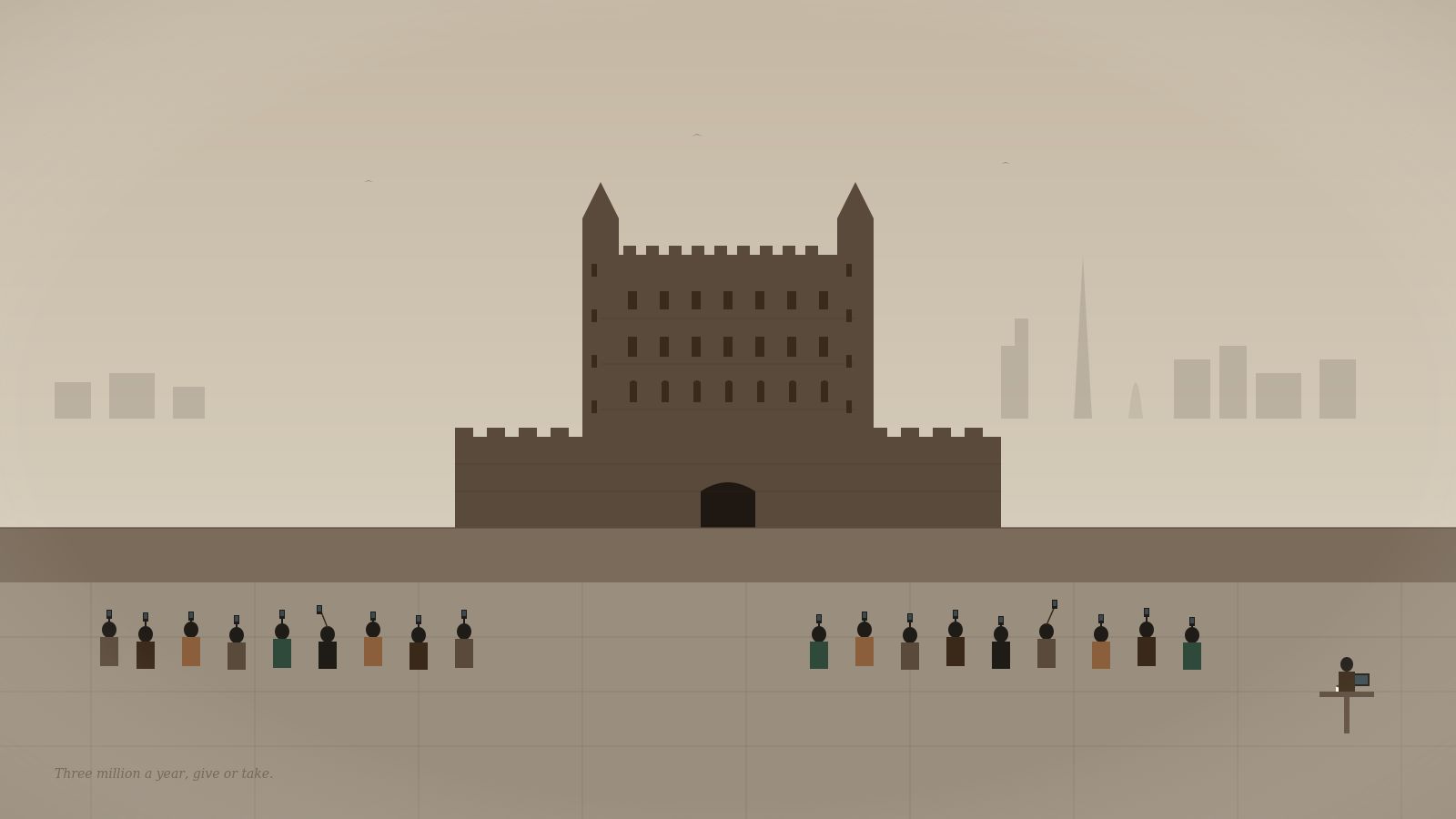
I am sitting at a café table near the Tower of London with a laptop open and a coffee growing cold beside it, writing a piece about the people walking past me.
That should be the first thing I say. It is the only thing that gives me any right to say what comes next.
Three million people come here every year. Three million. They queue, they shuffle, they pay their entrance, and they file past a set of crown jewels on a moving walkway that gives each of them about ninety seconds of viewing time before politely carrying them onward. Most of them, if you stopped them on the way out and asked what they had felt in there, would have to think about it. Most of them, honestly answering, would tell you the queue had been long, the lighting had been dim, and a child somewhere in the line had been crying. The jewels were nice. The jewels were definitely there.
But the photo of the building is good. The selfie at the gate is good. The geotag has been added. The post will do well.
We do not really come for the jewels.
We come because the Tower of London is the kind of place that, if you visit London and do not visit it, you are required to explain yourself afterwards. Why didn't you go? People expect to be told you went. And so you go. And while you are there, in a building that has held queens and beheaded them, that has watched a thousand years of English weather, you stand in a polite line with a phone in your hand and a small anxiety in your chest about whether the light is good enough for the picture. The history does not enter you. You enter it for ninety seconds, on a moving walkway, and then you exit through the gift shop.
I am being unkind, and I know I am being unkind. So I will say it about myself first.
I have done all of this. I have queued for the same things, taken the same photograph, posted the same caption. In London for a few days, what a city. I have looked up at a thing I did not understand and pretended, for the camera, that I understood it. I have spent a year of careful saving on three days of careful posting. I am writing this on a laptop two hundred metres from a moat that was once full, and I am writing it in a café whose name I will mention in the caption when I post the link.
So this is not a piece about other people. There are no other people. There is only us.
It is the same in Amsterdam, where people who do not particularly want to walk through the Red-Light District walk through the Red-Light District, because that is what one does in Amsterdam. They roam, they stare, they spend a year's savings in three days, and whether they participate in the place or not, the place participates in them. The old line, that even those who do not get fucked, get fucked, applies, more politely, to most modern travel. The city has its way with you. You leave thinner in the wallet, fuller in the photo roll, and not entirely sure what just happened.
It is the same in stadiums. We do not, in any honest sense, watch the game. We queue, we shove, we find the seat. We hold the phone above our heads to film a moment we are not actually watching, because we are watching the screen on which we are filming it. We post the clip before half-time. We refresh, on the way home, to see how many people have liked it. We tell ourselves the score, but the score was never the point. The point was the proof of attendance.
I noticed, sitting here today, that I cannot remember the last live event I attended without my phone in my hand for at least half of it.
The like is the currency. The heart, the share, the quiet little spike of dopamine when someone we have not spoken to in eight years registers, with a tap, that we exist. We perform for an audience that is not really an audience. They scroll past our lives at the same speed they scroll past everyone else's lives. They like us partly because they hope we will like them back. Quid pro quo, in the most exhausted Latin imaginable.
And the strange thing, the genuinely strange thing, is that we have started to feel things based on what these distant scrollers do with their thumbs. Our moods rise and fall on the engagement of people we will never meet. A post that does not perform feels like a small grief. A post that does perform feels, for about an hour, like being loved.
This is not how a person was supposed to be calibrated. This is not, I think, how anyone wants to be calibrated. But we wake up and check the numbers anyway, and the numbers tell us how the day is going, and we let them.
I notice all of this, today, near the Tower of London, with my laptop open. I notice that I am also a tourist. I am also writing a piece partly to be read. I am also, somewhere underneath the irritation, hoping that the people who scroll past this will like it, and that the like will register, briefly, in the part of me that has been trained to wait for it.
Writing about the herd has its own market. The herd is happy to read about the herd, because each member assumes the writing is about the others. Not me. The man in the queue ahead of me. The woman with the selfie stick. The couple with the matching outfits. Them. And I know, sitting here, that some of you will read this and think the same thing, not me, them, and the piece will work anyway, the way these pieces always work, because there is always a herd over there to point at.
So I will end with the only honest thing I have to say.
I am one of three million tourists. Whatever I am critiquing, I am also doing. I do not have a way out of this, not a real one, not yet. I have only the small, slightly embarrassed habit of noticing it, and writing it down, near a tower that has watched a thousand years of people doing exactly the same kind of thing in exactly the same kind of way.
The tower does not seem to mind.
Maybe that is what a thousand years buys you. The patience to watch each generation rediscover, with great seriousness, that they are also a little ridiculous.
I will pay for the coffee soon. I will walk past the queue on my way out. I will probably take a photograph.
Hassan
Letters, occasionally
"Subscribe to receive the next entry when it lands."